The Human Firewall: Hacking the Drama Before It Hacks Your Child 🛡️
Technology didn’t fail—the apps were doing exactly what they were designed to do. Learn how to build your child’s 'Human Firewall' to handle the emotional punch of a digital world that can be fast, loud, and sometimes unkind.
I have spent many hours building what I thought was the perfect digital perimeter. In the previous article I talked about reading the "ingredient labels" of our apps, and I’ve followed those steps religiously. I’ve configured the "Approved Content" on YouTube Kids, set the privacy toggles on our gaming consoles, and locked down the app store. I felt secure in the fortress I had built.
But eventually, a message always slips through.
It usually isn't a master hacker or a classic "predator." It is something much simpler and more common: a stinging comment in a game chat that says, "You build like a baby," or the silent hurt of being kicked out of a friend's group chat.
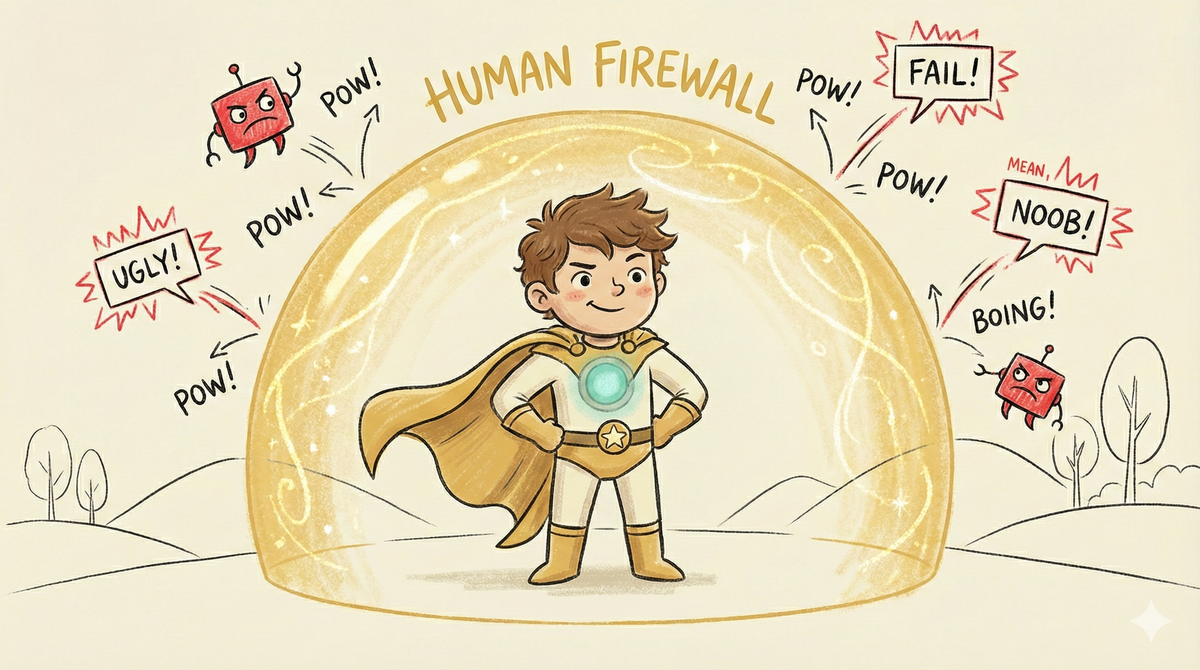
In those moments, I realized the technology didn't fail—the apps were doing exactly what they were designed to do. What needed strengthening was the "Human Firewall"—my child’s ability to handle the emotional punch of a digital world that can be fast, loud, and sometimes unkind.
Hacking the Drama
I don’t try to block every mean comment on the internet anymore; I’ve accepted that is an impossible task. As I laid out in the mindset article , we are moving from the "digital native" to the "AI-native" generation. Technology is no longer just a tool; it is an active agent capable of dialogue and influence. This shift requires a "pedagogy of engagement"—a way of teaching our kids to interact—rather than just counting screen-time minutes.
When my child comes to me upset, I resist the urge to just ban the game. Instead, we sit down and "debug" the situation together using a strategy I call Hacking the Drama:
I ask them to name the feeling. Is it anger, embarrassment, or sadness? Naming the "bug" is the first step in hacking it.
We look at the source. If it’s a person, we ask: "Do happy people go online to wreck others' creations?" If it’s an AI, we remember it’s just a "Super-Powered Pattern Matcher" without a brain or genuine empathy.
We decide if the message deserves a response. We ask: "Does this person (or bot) deserve my energy?" Usually, the "monster" on the screen shrinks the moment we stop feeding it our attention.
We ensure no sensitive "human" tasks—like figuring out who we are or fixing a friendship—are being offloaded to a machine. We ask: "Is this a problem for a chatbot, or a problem for a human friend?" to ensure they aren't taking advice from a machine that might "hallucinate" or guess.

The Hero’s Training: Digital Vitamin C
Teaching these abstract concepts to a child is tough, so I rely on specific tools from the Cyber Power Toolkit to do the heavy lifting. In the App Index, I’ve labeled Spoofy as "Digital Vitamin C."
It is a game designed specifically to build their "Human Firewall":
- Safe Practice: My child plays as a Cyber Hero solving social problems and deciding who to trust.
- Shared Language: Playing it together gives us a vocabulary. When real-world drama hits, I just ask, "Remember what the hero did in Spoofy?"
- Combatting the "ELIZA Effect": It helps them recognize our natural tendency to attribute human-level understanding to code. We use scripts to remind them: "The chatbot is just math trying to sound like a person; it doesn't actually have feelings."
How I Teach This (The Modeling)
I’ve had to accept that I cannot protect my children from ever feeling sad. But I can show them that they are the masters of their own internal firewall. Parental awareness is often skewed toward "legitimate" academic uses, but we must be present for the social and emotional interactions too.
I try to model this myself through a "Think Aloud" protocol. If I see a frustrating email or a mean comment online, I talk about it out loud:
By doing this, I’m not just policing their apps. I am preparing them. I am teaching them that while they can't control the traffic coming at them from the internet, they own the code that decides what gets through. They learn that they can feel when their brain is getting tired and know when to disconnect. They start to sense when an algorithm is "hooking" them and use a "Human-in-the-Loop" mindset, ensuring they are always the ones providing the intent and final verification for anything they create.
What’s Next?
Building the Human Firewall is about protecting our children's hearts. But what about their data? In the next article, I will go behind the scenes to look at The Law. I’ll explore how to maintain a digital perimeter around our family's personal information and understand our rights in a world that wants to turn our child’s data into a product.