The Admin Console: Claiming Your Rights in a Data-Driven World
I used to feel powerless against giant tech companies. Then I realized that as a parent, I have an Admin Console—a set of legal rights like the GDPR and BIK+ designed to protect my family's digital perimeter.
We’ve talked about the "ingredient labels" of our apps in the article about manuals and the "firewall" of our children’s hearts in the article on the human firewall. But there is one more perimeter we need to secure, and it’s the one that often feels the most invisible: our family’s data.
In the physical world, I wouldn't let a stranger walk into my house, take photos of my children's drawings, or record their private conversations. But in the digital world, data—the "mystery ingredient" we’ve been tracking—is being harvested every second. This is especially true now that our children are using AI for sensitive developmental tasks like identity exploration or emotional support. These interactions leave no public footprint, making our "digital perimeter" more permeable than ever.
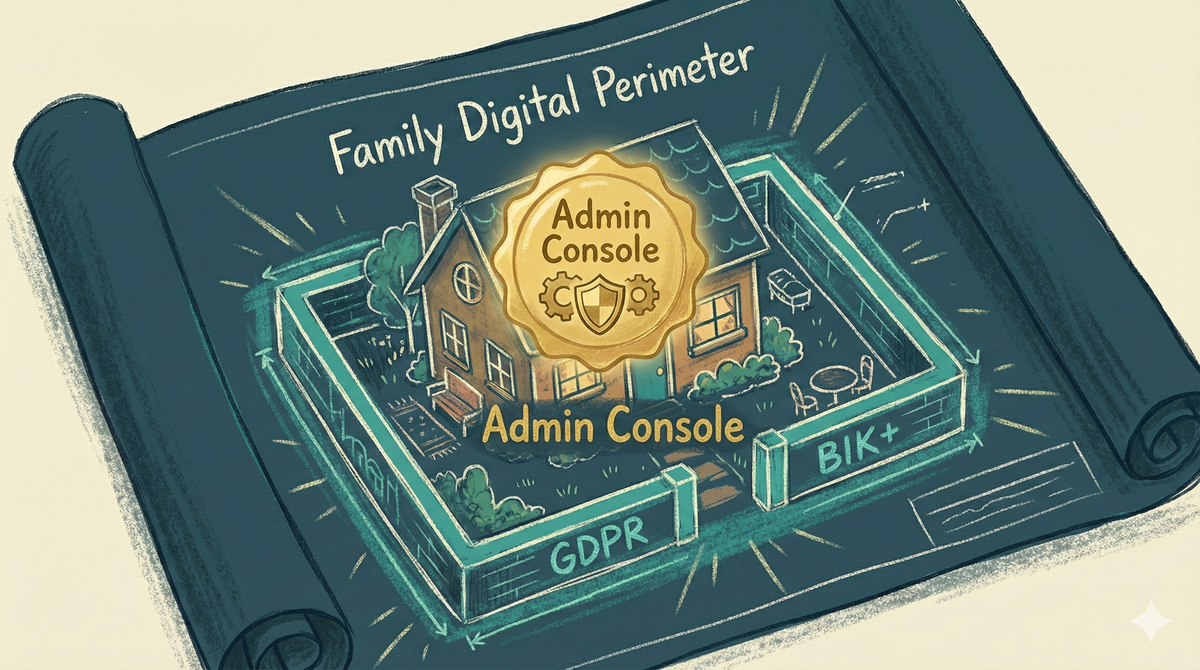
I used to feel powerless against these giant tech companies, as if my only choice was to "Accept All" or be left behind. But then I realized that as a parent, I have an Admin Console. I have a set of legal rights designed specifically to help me maintain a digital perimeter around my family.
Your Rights as a Digital Architect
Today we are backed by powerful "gold standards" like the BIK+ strategy and the GDPR. These aren't just boring legal documents; they are the blueprints for our family’s safety.
Here is what is inside your Admin Console:
By law, apps designed for children must have the highest privacy settings turned on automatically. If an app asks for my child's location or microphone access for no reason, that's a breach of my perimeter.
Features like infinite scrolling and autoplay—those "dopamine loops"—are now under heavy scrutiny. I have the right to demand tools that don't exploit my child's vulnerabilities or use "subliminal techniques" to manipulate them.
I have the power to ask any company to delete my child’s personal information. This is the "reset button" for my digital footprint.
Companies cannot use my child’s data to train a global AI model or show them targeted ads without my explicit, "freely given" permission.
Before a single byte of data is collected from a child under 13, the app must obtain my verifiable consent. I have the right to review, revoke, and delete that data at any time.
If my child is talking to an AI, the app must be clear about it. It cannot pretend to be a human "friend" without my knowledge.
Using Your "Magic Keys" 🔑
To make these rights practical, I teach my kids about "Magic Keys" (also known as Digital Identity frameworks).
Think of a "Magic Key" like a VIP Wristband at a theme park. When you show your wristband to get on a ride, the operator doesn't need to see your birth certificate, your home address, or your full name. The wristband simply "flashes" a green light that says: "Yes, this person is tall enough for this ride."
In the digital world, we use these secure "keys" to prove a child is the right age for an app without handing over their entire identity to every company that asks. It’s a way of saying, "I’m allowed to be here," without leaving our front door key under the doormat for everyone to find.
To help me navigate this, I use the tools from the Cyber Power Toolkit called The Shield. It’s a directory of the "Inspectors" we talked about earlier—the digital village that helps us enforce these rights.
How I Teach This (The Modeling)
I don't just talk about privacy; I show my kids how I manage the "Admin Console" for our whole family. When we download a new app together, we do a "Privacy Checkup":
- Permissions Audit: We look at the list together. I ask: "Why does this math game need to know where we live?"
- AI Training Check: We go into the settings of any AI tool and turn off "Chat History & Training." I explain: "We don't want strangers reading your diary to teach their robot."
- Spotting "Dark Patterns": We look for those tricky buttons designed to make you say "Yes" when you mean "No."
- Data as a Trade: I tell them: "If the app is free, our information is usually what's paying for it. Is this game worth that price?"
By doing this, I’m showing them that they aren't just "data points" for a company to harvest. They are Rights-Holders. I am teaching them to walk through the digital world with their heads held high, knowing they have the power to say, "My data, my choice."
What’s Next?
We’ve built the labels, the firewall, and the admin console. But even the best-designed perimeters can sometimes be breached. In the next article, we’ll talk about The Crisis—a calm, step-by-step guide for what to do when things go wrong, from cyberbullying to the new world of AI-generated deepfakes.